Search

Amy F. Quincy Author/Freelance Writer

Tag

disabled

Have Power Chair … Will Travel

I am SICK TO DEATH of bumming rides.  (Okay, I know it’s a cliche’, but I can’t think of anything original.  Fellow writers, help me out here.)  Since I don’t drive, I’m forever asking favors.  Do you mind and could you please take me to the drugstore/grocery store/doctor’s office?  With my mother recovering from an illness and also unable to drive, it’s really starting to wear on me (yes, another cliche’.)  One thing I’ve learned being disabled, people genuinely want to help.  It makes others feel good.  It makes me feel like an eight year old in tights being chauffeured to gymnastics.

I’ve tried relying on the public transportation available to me.  If you’ve read my memoir excerpt “Riding the Short Bus.” you know I occasionally ride JTA’s door-to-door bus service for the disabled.  It has some shortcomings.  If I schedule a 10:00-10:30 a.m. pick up to go to Publix, the earliest I can schedule a ride home is 12:00-12:30 p.m.  I could be shopping by 10:15 a.m., but not be home until 1:00 p.m. or later.  Better not get ice cream.

If you’re beach bound only, there’s also Dial-A-Ride.  I experimented with that service last week.  First, there was no answer.  This did not bode well for Dial-A-Ride.  Or for me.  Then, though I had called the required 24 hours in advance, they were all booked up.  When I picked a different day, they told me what time I would be going shopping.  I had to be available all day.  Hey, I’m disabled, right?  I have nothing better to do. Continue reading “Have Power Chair … Will Travel”
Riding the Short Bus: An Excerpt

One evening, I was on my way home from the outpatient gym.  I’ve fallen into a bad habit since the hemorrhage.  Or maybe it’s not so much bad habit as it is human nature.  I’ve been comparing.  I see a lot of disabilities now and I decide in my head if someone is better or worse off than me.  It’s terrible I know, but it’s what I do.  Amputee?  Better off.  Prostheses are amazing now.  Mentally challenged but can walk?  Worse off.  I don’t think I’d trade my mind for any physical ability.

A blind woman was already on the bus when I was picked up.  I realized she was blind when I said hello and she responded in my general direction but seemed to make eye contact with my left shoulder.  Her eyes looked layered over with coke bottle glass.

Next we picked up a woman obviously coming from work.  She suffered from dwarfism.  I believe the politically correct statement is that she was a little person.  She couldn’t have been much over three feet high and she dragged a suitcase on wheels.  Her pudgy fingers were wrapped around a handle, that if extended, would have been well over her head.  I watched her begin the laborious climb up the three steps of the bus.  First she heaved the bag up one step and rested her hands on top of it while she positioned her feet on the step below.  The driver offered to help but she declined.  I stole a glance as she buckled her seat belt.  Her legs extended flat across the seat, her feet barely dangled over it.  Occasionally, I run across things I can’t reach or a car blocking my access to a curb.  I hate it when friends or well-meaning people put stuff in the very back of my freezer.  Or on the bar in the kitchen or on top of the fridge.  Or any other of the multitude of places that I can’t get to.  But this is only on occasion.  Her entire world is oversized.

Our motley crew continued on down Beach Boulevard when the driver stopped for a light.  I heard music coming from a Ford Explorer in the next lane.  A blonde had the window rolled down and her elbow out, resting on her knee.  I used to drive like that.  One foot tucked up under me.

The blonde turned to look at the bus and I felt grateful for the tinted windows.  I used to look at the short busses too, the blue handicapped symbol on the back, and wonder about the poor souls on board.  Now I’m on the inside.

The sun was setting so spectacularly that evening that I’m sure it would have warranted comment by the driver or passengers if one of those passengers hadn’t been a blind woman.  So instead, we all sat respectively silent in the warm glow of pinks and reds.  I watched as the woman adeptly handled her cell phone to call a friend, then a Chinese take-out place, something I can never do without misdialing or dropping the phone altogether.  Then I listened as she inquired about the specials and placed her order.  This is also something I cannot do as I’m hard to understand and often misunderstood or hung up on like a prank caller.  I thought about her eating her fried rice, something I avoid because it falls off the fork.  Then I turned in time to see the last of the pink sun sink beneath the horizon.

The Kindness of Strangers

“How many people are here?” Ed asked me.

“I don’t know,” I replied.  “A hundred?”

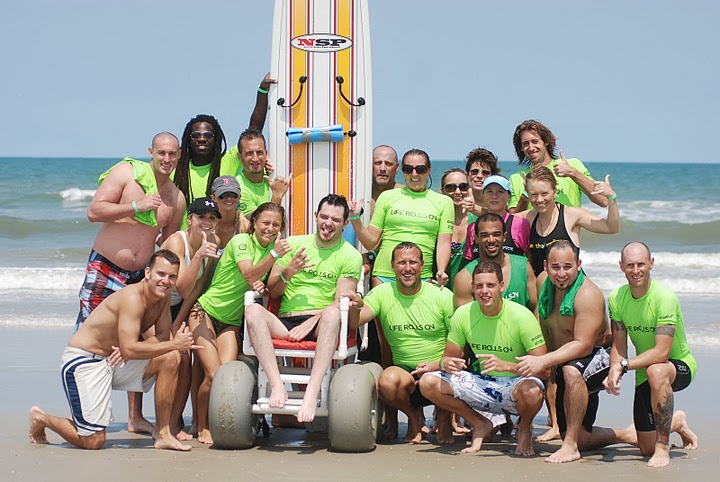
It was almost three times that.  You would think the smoke that hung thick in the air that day would have discouraged some, but it was a large turnout for the Life Rolls On “They Will Surf Again” event in Jacksonville Beach, June 4th.

I saw the advantage of owning my own beach wheelchair right away, but other beach chairs were on hand at the lifeguard station to ferry people over the soft sand or into the water.  Some folks braved the sand in their regular wheelchairs.  Ed pushed my chair down by the water to wait my turn at “surfing.”  He was a friend of my friend, Amy, and I’d just met him, but he had volunteered his truck to tote my dune buggy of a beach chair to the event.

I’d done this once before (this was Life Rolls On’s fifth year in Jacksonville,) but I was struck again at the large number of volunteers.  There were 12 able-bodied volunteers for every disabled surfer.  When it came my turn, I understood why.  It took six or seven people just to get me out to where the waves were breaking, then shove me off in time to catch one.  And volunteers were lined up all the way to the shore to grab me wherever I happened to fall off.

Friends (clockwise) Ed, Kathy, Me and Amy. Photo by Sharon Daniel

A subsidiary of the Christopher and Dana Reeve Foundation, Life Rolls On originally started the “They Will Surf Again” program for people affected by spinal cord injury.  The number of participating disabilities has grown to include brain injuries, amputees, varied birth defects and others.

After about my third ride to shore and face full of salt water, I remembered overhearing someone talk about surfing on their knees.  Anxious to avoid the stinging spray from my position lying down on the board, I asked if I could try sitting up.  This meant a volunteer would ride tandem.  This video is the first of two rides I made like that.  Now that I know it’s an option, I’m certain there will be many more.  My own hooting and hollering was drowned out by that of the volunteers.

I was touched by the enthusiasm, positive attitude and smiling face of each person who assisted that day.  I’m not sure who got more out of the experience, the surfers or all those willing to lend a helping hand.

If you’ve followed my blog you know I like to say “disability has its perks.”  Here’s another one: being disabled allows me to see the good in people.  I’m in the unique position of seeing people at their best.  I am reminded of the generosity of the human spirit almost every day when someone holds open a door, untangles Frankie’s leash or waits for me to slowly cross the road  in my power chair.  And it’s a good thing too, because with a little help, life does indeed, roll on.

Lanes 29 and 30: Intro to Adaptive Bowling

I don’t feel like going.  I have homebody tendencies that have only increased since becoming disabled.  I wasn’t crazy about social situations before, but at least I fit in.  Now I’m in a wheelchair, don’t like eating around groups because I’ll shake and be lucky to hit my mouth, and have to drink through a straw.  I always had beer at the bowling alley.  And I ask you, what’s bowling without beer?

But, I go for several reasons.  I’ve met many nice people in the program (Brooks Adaptive Sports and Recreation Program) that I want to see.  And my mother has drilled this concept of “socialization” into my head.  I should connect with my peers.  In other words, it’s important to have disabled, as well as able-bodied, friends.

It’s always interesting, being part of this group.  I’ve done things I never imagined doing again.  I’ve played pool, ridden horseback, and rowed the St. John’s River. None of them well, but still.   I can’t fathom how I will bowl when I picture my old long-legged approach.  But to think technique is to miss the point.

The last two lanes closest to the ramp that lead to the polished wood floors belong to our motley crew.  Nearly all of us are in wheelchairs.  Some of us, like me, take erratic swings in the lane with the “gutter guards,” those rails that keep the ball traveling toward the pins.  Some of us chuck the ball down the lane with a loud crash.  Some of us, lacking grip, use metal ball ramps to release the ball.  All of us begin at the foul line.

It would be far easier to stay in than worry about if there will be steps, or if I can eat something there, or how silly my beer will look with a straw sticking out of it.  But, if I only surrounded myself with able-bodied people, I’d never measure up.  I’d always see things in terms of what I couldn’t do, instead of what I could.  I’d stay home and play hostess to my own one woman pity party.

As I am leaving someone uses a phone to look up my new website and reads about what happened to me.  He is an amputee.  “How sad,” he says.  “I’m sorry.”  I am momentarily taken aback.  No one disabled has ever said this to me.  And then I realize.  Maybe I make him feel grateful.

Remember, there is always someone worse off than you.  Today, do something that keeps you grateful.

Downhill in a Bucket: Intro to Disabled Skiing

Skiing was one thing I was sure I would never do again.  I had loved to ski.  I loved being outdoors, away from the hot, flat terrain of Florida.  I loved the physical exercise, the cold wind in my face.  I loved the rush of adrenaline as I dared myself to go faster, steeper.  So when my friend Tracy called last year to see if I wanted to try adaptive skiing when I visited Colorado, my answer was an emphatic “no.”

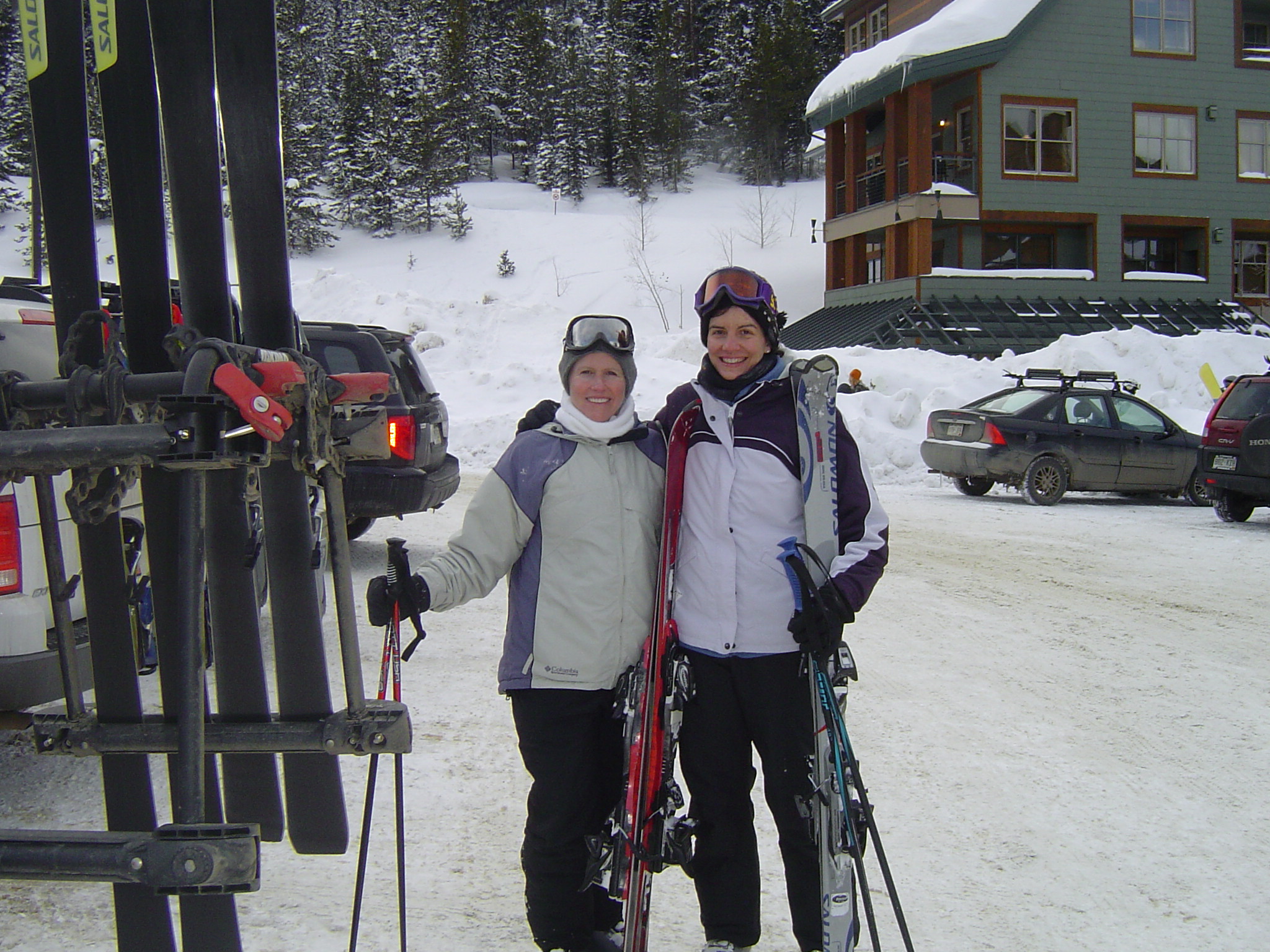
Tracy (left) and I ski Winter Park before my hemorrhage.

Then, I reconsidered.  I’m usually game to try anything — once.   I agreed, as long as it was understood that I might hate it and want to quit after the first day.  We made plans to return to the same mountain we had always skied together in Winter Park, Colorado. Continue reading “Downhill in a Bucket: Intro to Disabled Skiing”

Website Built with WordPress.com.

Up ↑