 I believe that eventually the world gets it right. Just think, there was a time, not too long ago, when women weren’t allowed to vote and the color of your skin dictated which water fountain you had to drink from or where you were allowed to sit. Our children may find that hard to believe. But I believe in another 50 years or so, our children’s children will find it hard to believe that gay people didn’t always have equal rights or that there were actually public places a disabled person couldn’t get to. It takes what it takes (usually a lot struggle), but the world eventually comes around.
Yes I know, I’m getting a little political, but I am, after all, my mother’s daughter. It hit me while watching a rerun of Will and Grace. That show was groundbreaking at the time. Now it seems old hat, the way Modern Family will seem in the future. And something else groundbreaking is happening. NBC is televising the Paralympic Games for the first time in history.
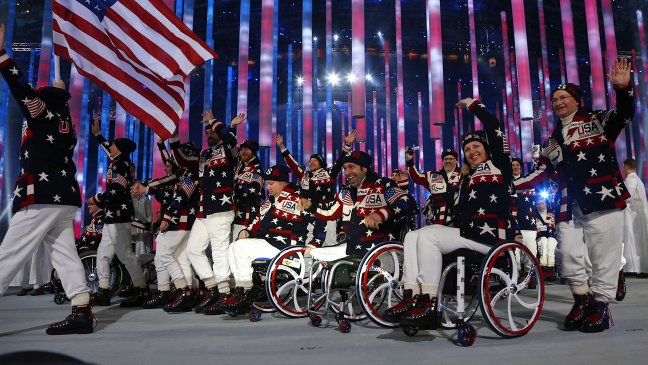
During the London Paralympic Games, I was petitioning to have NBC televise them. Now, I’m asking you to watch them this week. I’ve found them on NBCSN (which is channel 24 if you have Comcast.) It’s not exactly prime time viewing with Bob Costas, but it’s a start. And as the president of the International Paralympic Society said during the opening ceremony which illustrated the theme ‘Breaking Down Barriers’, “I call upon all those who experience these Games to have barrier-free minds.”
Original Post: Changing Times
“Look up at the stars, not down at your feet. Be curious.” ~Stephen Hawking
If you’re like me, your favorite part of the Olympics is the human interest stories. Someone who seems destined for greatness, loses and then, struggling against all odds, fights their way back to the top again. If you are moved and inspired by these stories, then you’re going to love the Paralympics. Every single athlete is a human interest piece. Everyone’s got a story to tell.
In case you don’t catch it (and why would you? It’s not televised in the U.S.,) you can watch the Games online. I’ve been watching Paralympic Sport TV. The only problem with this is that I remain hunched over my computer instead of in the comfort of my own living room. If you, too, would rather be watching it on the big screen instead of a small one, my little petition is still struggling out there in cyberspace, so sign it!
The Paralympic Games, which started August 29th and continue until September 9th, started with an opening ceremony extravaganza, held in front of a record audience of 62,000. It began with inspiring words from Professor Stephen Hawking and featured deaf and disabled performances.
This was a homecoming of sorts for the Paralympics because, although the first official Paralympic Games was held in Rome in 1960, the idea was founded in Stoke, just north of London in 1948. Sir Ludwig Guttman began the revolutionary practice of using sports in the rehabilitation of spinal cord injury patients with just 16 athletes on a small piece of land between the back of a hospital and a railway embankment. It has grown steadily to 2012, with over 4200 athletes competing from over 160 countries. Sir Philip Craven, President of the International Paralympic Committee, thanked Sir Ludwig Guttman for “generating the first sparks that became the Paralympic spirit.”
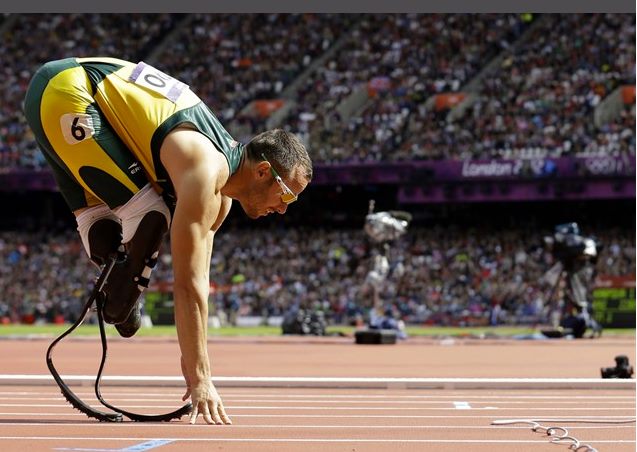
As I scanned the U.S. athletes for sight of my friend Jerry, a Paralympian I met back when we both tried wheelchair tennis (he found his sport in archery – see the previous links,) I found it impossible to keep a dry eye watching the athletes take part in the night of their lives. The Paralympic athletes are a celebration of the human spirit, a testament to the amazing things a body, particularly a disabled body, can do. Isn’t that what we love about sports? And the growing Paralympic movement, with more people watching than ever before, is a sign that we are one step closer to an inclusive society. These are, indeed, changing times.
 Amy F. Quincy Author/Freelance Writer